
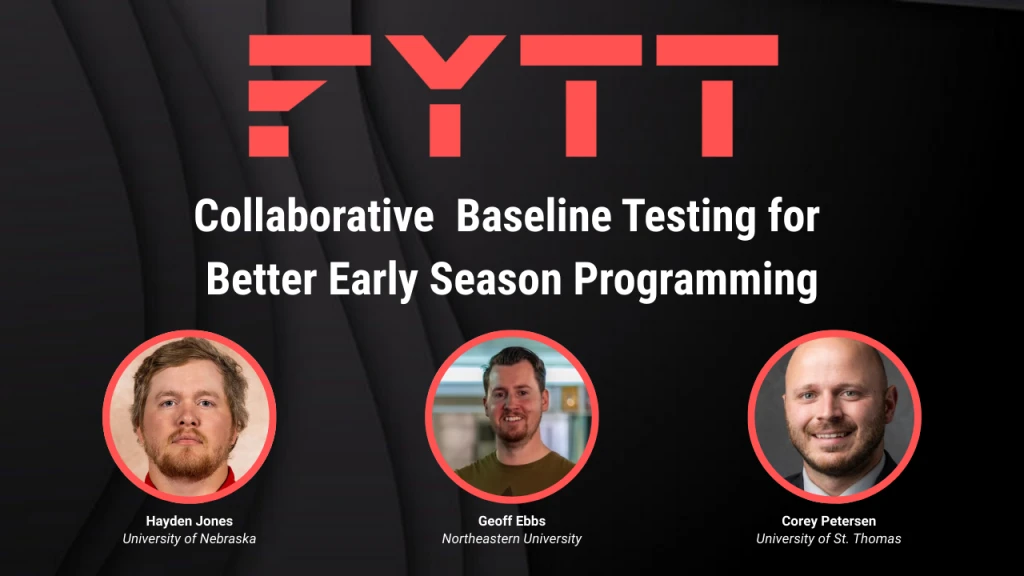

In this practitioner roundtable, FYTT CEO Eric Wynalek sits down with three experienced collegiate strength and conditioning coaches — Geoffrey Ebbs (Northeastern University), Hayden Jones (University of Nebraska), and Corey Petersen (University of St. Thomas) — to unpack how baseline testing drives smarter early season programming. From defining KPIs and selecting meaningful tests, to running efficient multi-day protocols, to breaking down silos between S&C, sports medicine, sport science, and nutrition, the panel shares real-world strategies that work in both high-performance and resource-limited environments. Listeners will walk away with actionable ideas for individualizing training, improving communication across performance staff, and translating testing data into daily programming decisions.
Eric Wynalek (CEO, FYTT)
Welcome, everybody. Today’s topic is Using Baseline Testing for Early Season Programming. We have an esteemed group here to discuss it. My name is Eric Wynalek, CEO of FYTT, and we’ve got three excellent coaches to walk us through this topic.
The intent is to give value whether you’re a collegiate or high school coach bringing athletes back onto campus, a professional coach preparing for the season, or a performance training gym owner working with multi-season athletes. You’ll hear how others are doing it, and hopefully walk away with actionable ideas.
Jeff will start by covering what testing is—getting everyone on the same page with terminology and purpose. Hayden will talk through the logistics of running successful tests. Corey will finish with how to collaborate across the performance team—strength and conditioning, sports science, sports medicine, nutrition, athletic trainers—so programming is aligned across the department.
At FYTT, we’re an athlete development company focused on maximizing health and performance. Our SaaS platform allows you to onboard athletes, bring coaches together, run full-season plans, and integrate performance data. We work with pro, college, and private performance organizations.
Geoff Ebbs (Head Strength & Conditioning Coach, Northeastern University; Owner, Wave Strength Performance)
Thanks, Eric. I’ll start with my perspective on testing. My main points are:
Define everything. Get granular with your KPIs and variables—clear definitions, clear understanding across all stakeholders.
Recognize interconnectedness. Everything affects everything in an athlete’s system.
In my world at Northeastern, stakeholders include S&C coaches, sports medicine, PT, physicians, coaching staff, and athletes themselves. A concrete framework lets everyone communicate using the same definitions and values.
For me, performance testing is a series of assessments that:
Define and organize KPIs
Identify strengths and performance limiters
Act as a programming roadmap
Once KPIs are defined and valued, you can determine what truly moves the needle for each athlete. That varies by sport, position, training age, structural/physiological bias, and other individual factors.
The next step is understanding how KPIs are interconnected. Improving one area often comes at a cost somewhere else—especially with elite athletes. This “systems thinking” mindset helps predict second- and third-order effects.
Testing should happen at baseline and be embedded throughout the year so you can track changes.
Example:
A high-level baseball shortstop scored extremely high on RSI (4.10), indicating elite stiffness/reactive strength—but also correlated with a history of soft-tissue injuries. Instead of trying to increase force output, we programmed to reduce stiffness and increase range of motion. Over time, impulse output improved, change of direction improved, and injuries decreased. He went on to a healthy senior year and was drafted into MLB.
Bottom line: An effective testing battery creates a framework where everyone involved in the athlete’s journey can operate and communicate clearly.
Hayden Jones (Strength & Conditioning Coach, University of Nebraska)
When I arrived at Nebraska, I wanted to revamp baseline testing to set us up for success—especially on the rehab side. Without knowing where an athlete started, it’s hard to know where they need to return to after injury.
Baseline testing also reveals asymmetries and weaknesses you can’t see with the naked eye. This has been huge for us, especially for ACL rehabs.
We split our testing into three groups over one week in summer so athletes could focus without fatigue:
Group 1
Abduction/adduction (force frame)
Jumps with force plates + motion capture
Group 2
VO₂ max testing
Isometric squat (used for DSI programming)
Nordic hamstring (important for soccer)
Bruce treadmill test
MAS protocol
Group 3
Range of motion (quad, hamstring)
Seated ankle ISO
All data goes into visual athlete reports with team norms and PRs. This allows us to have clear conversations with athletes about why they’re on specific programs.
In-season testing:
Daily: wellness and RPE surveys
Weekly: CMJ and sprints (adjusted based on game loads)
Every 2–3 weeks: ISO squat, Nordic
Every 4 weeks: abduction/adduction
The goal is to use the data—share it with athletes, then individualize programming accordingly. With FYTT, we can have 4–5 variations of a workout for a 20-athlete squad, all tailored to needs.
Corey Petersen (Strength & Conditioning Coach, University of St. Thomas, Men’s & Women’s Hockey)
Testing is only valuable if we collaborate across disciplines. Too often, departments work in silos. We need shared conversations with athletic trainers, nutritionists, sports psychologists, and sports scientists.
For example, our men’s hockey “support team” includes:
Head coach (must understand testing value and outcomes)
Sports scientist (lab testing, DEXA, BodPod, metabolic cart)
Athletic trainer (key partner for rehab and daily readiness)
Nutritionist (fueling strategies)
Sports psychologist (performance mindset)
Relationships matter. I set up regular informal check-ins—like weekly coffee with the athletic trainer—to align philosophies and communication styles. That trust makes in-season problem-solving much smoother.
In FYTT, we integrate rehab, prehab, and S&C into one program view. Athletes see everything in one place, and we can all track changes.
Grouping athletes by testing outcomes (e.g., force producers, velocity-based power, movement quality) allows efficient adjustments without writing entirely separate programs.
Geoff Ebbs – Individualization Example
Two athletes on the same team can respond totally differently to the same conditioning protocol. Using muscle oxygenation testing, I identified one as an “extraction” type (uses oxygen quickly, lactate-dependent) and one as a “delivery” type (receives oxygen faster than needed). They require very different training approaches.
With FYTT, I can bucket athletes into groups and build conditioning blocks specific to each profile—while still maintaining group training flow. The goal: improve performance limiters without diminishing strengths.
Hayden Jones – Decision Trees
FYTT’s decision tree feature lets me automate group assignments based on test data like RSI and DSI. After each test, athletes are auto-added or removed from groups, and programming updates instantly. That way, we’re not manually reassigning after every test.
Q&A Highlights
How much early season programming do you pre-plan vs. let testing decide?
Start with foundational movement patterns (squat, hinge, push, pull) and adjust based on testing.
Modify via small constraints (box squat, band assistance, eccentrics) to create the desired adaptation.
Avoid overcomplication—patterns stay the same, but intensity, tempo, and load vary.
How often do you rebucket athletes?
Typically every 2–3 weeks or after significant testing points.
Avoid making changes after one poor score—look for trends, confirm with conversation and observation.
Final takeaways:
Testing is a tool to guide, not dictate, programming.
Collaboration across departments is critical.
Share results with athletes to drive buy-in.
Use technology to streamline data flow and group management.