


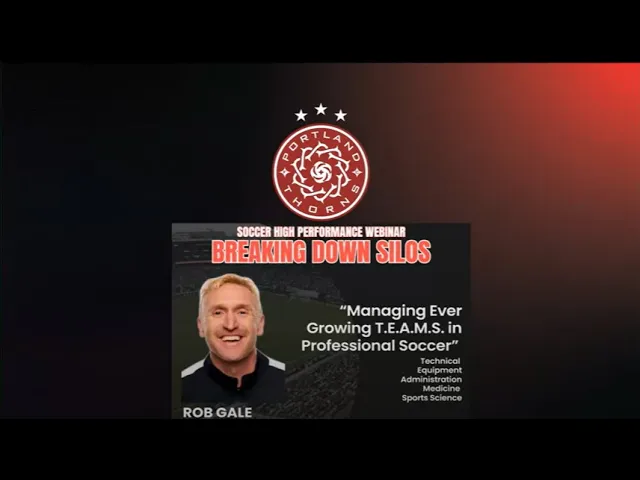
Originally recorded as part of FYTT’s Soccer High Performance Webinar Series
When Rob Gale stepped into the interim head coach role at the Portland Thorns just four matches into the 2023 NWSL season, he inherited not only a team but a complex ecosystem of performance departments. With over 20 years in professional football—including stints with Canada’s men’s national teams and NYCFC’s academy—Gale brought a collaborative, results-driven approach to managing the many moving pieces of elite sport.
In this interview-style recap of FYTT’s high-performance webinar, Rob shares how he leads across departments, structures training environments, and defines what true “availability” means in elite soccer.
FYTT: You’ve coached at nearly every level—from national teams to youth academies. What’s changed the most over the years?
Rob Gale: The game has gotten more complex. As a head coach now, you're not just managing the technical piece—you’re managing the entire performance ecosystem. Medical, sport science, administration, logistics, equipment—you have to coordinate all of it. And ultimately, the buck stops with you.
FYTT: You said the technical department is where you spend most of your energy. What’s your approach there?
Gale: Vision and clarity. I use a model I originally built at Valor FC that outlines our game model across four moments—attacking organization, attacking transition, defensive organization, and defensive transition. Each moment has two or three clear principles and match cues. We print this and post it in the locker room.
Our staff is small—just two assistants, a goalkeeper coach, and an analyst—so it’s critical that we all work off the same blueprint. Everyone owns a piece of the daily session. It’s not micromanaged, but it’s coordinated with clarity.
FYTT: How do you ensure the team is physically peaking on game day?
Gale: Periodization drives everything. We map out the entire month—recovery days, technical vs. tactical sessions, gym top-ups, travel, matchdays—then refine it weekly.
Each day includes a 7:30 a.m. staff meeting to align, then an 11:00 a.m. pitch session. Our sport science and medical teams provide player availability every morning, including what percent of the session each player can handle. That drives how we plan both the collective and the individual workloads.
FYTT: Speaking of availability, you redefined what that means at Portland. Can you explain?
Gale: When I arrived, there were vague ranges like “15 to 30 minutes available.” That doesn’t help me win games. Now, if you’re not available for at least 45 minutes, you’re not considered “available.” For starters, I expect 60 minutes minimum. I don’t want to be forced into a substitution unless it’s tactical.
That clarity helps my medical and performance teams build return-to-play protocols that match tactical demands.
FYTT: What’s the role of the equipment and admin staff in a professional environment?
Gale: Massive. We post field maps each day, so the equipment manager can lay everything out in advance. Between drills, they help clear setups and reset for the next phase. That keeps the session intense and fluid—just like match day.
Our admin team handles visas, housing, vehicles, social security numbers—everything a player needs to perform off the field. I always say: “How we exit a player matters just as much as how we welcome them.” A poorly handled trade or release hurts your reputation in the locker room and across the league.
FYTT: What does good collaboration look like between sport science and coaching?
Gale: No silos. We’ve built one shared Excel file that everyone can access—sport science, medical, technical, admin. That file drives daily decision-making.
We track GPS, high-speed runs, meters per minute, accelerations, decelerations—everything. But we don’t use data in a vacuum. My sport scientists know that performance pays our bills. So we blend science with the realities of the game. If Sophia Smith wants extra finishing, we find a way to support her without overloading.
FYTT: Any advice for young sport scientists trying to break into elite teams?
Gale: Don’t just quote numbers. Understand context. Support the coach’s plan. Learn what “availability” means in performance terms—not just medical clearance. Be a partner, not a roadblock.
FYTT: You’ve referred to substitutes as “finishers.” Why?
Gale: Language shapes identity. Calling them “subs” implies they're not first-choice. But when we’re missing nine players to international duty, those next players become starters. “Finishers” implies purpose—you're not just replacing someone; you're entering to win the match.
FYTT: Final thoughts?
Gale: Elite performance isn’t just about drills and tactics—it’s about clarity, communication, and culture. Break down silos. Respect every role. And remember: every department contributes to winning.
💡 FYTT Takeaway
Rob Gale’s approach embodies FYTT’s mission: integrating technical, medical, and performance staff into one cohesive unit. With clear planning, shared language, and a culture of collaboration, coaches can elevate both performance and player wellbeing.
Learn more about how FYTT powers high-performance teams → Free Trial