

Over the past several years I have been lucky to work with a lot of great practitioners, coaches, and mentors. Thematic planning is a concept I picked up from Mark Jamison, Assistant Athletic Director for High Performance at Southern Illinois University-Edwardsville (SIUE), during my time as a Graduate Assistant. In short, thematic planning is organizing all training stimuli over the course of a week to optimize both recovery and training adaptations. Most of my experience comes from working in soccer and track & field. Most of the time track & field provides a very straight forward approach for designing a weekly thematic plan. For example, a track & field sprinters event group coach in the collegiate setting might plan their week during an offseason period as follows:
Monday: Speed Endurance
Tuesday: Speed
Wednesday: Recovery
Thursday: Acceleration and Plyometrics
Friday: Speed Endurance
Saturday: Off
Sunday: Off
If a coach presented this plan to me, I would structure the group’s gym-based work as follows:
Monday: Power (before Speed Endurance work)
Tuesday: Max Strength and Hypertrophy (after Speed work)
Wednesday: Off
Thursday: Hybrid Session – Power, Strength, and Hypertrophy (after Acceleration and Plyometrics)
Friday: Off
Saturday: Off
Sunday: Off
In this scenario, athletes are set up to perform activities in an order which allows them to get the most out of their training on the track and in the gym. Something to keep in mind when
developing a thematic plan is that you are likely working under inherent scheduling constraints because of the population you are working with. There is also a good chance you are working with a sport coach who has had a lot of success operating under the weekly model they present to you.
Oftentimes, as a performance coach, you might sit there, look at the sport coach’s plan, and immediately think there is a better way for them to structure their week. This is where collaboration is key. In the above model, I had to fight hard to get the group into the weight room before their practice on the track on Monday. The concept of lifting before running was completely foreign to the sport coach.
Some of you might be sitting here asking, why would you ever want an athlete to do gym-based work prior to what might be considered sport specific work? Fair question, it’s same rebuttal that came from the sport coach when I proposed the idea. Sport coaches are oftentimes concerned with gym-based work because it might temporarily hinder an athlete’s ability to perform sport specific work due to fatigue and/or soreness. Rightfully so. However, when you consider what speed endurance work looked like for this specific coach, all the work was submaximal in nature and performed for relatively longer distances than the athletes run in their specific events.
Gym-based power work might include med ball (MB) throw variations, loaded jump variations, Olympic weightlifting movements or derivatives, and other ballistic movements. This type of work is typically performed with maximal intent and is highly demanding in terms of coordination and neuromotor unit recruitment. Considering this, it probably makes more sense for athletes to perform power focused gym-based work prior to speed endurance work on the track. In theory, the power work could serve as performance enhancement for the speed endurance work. The power work will likely recruit neuromotor units that an athlete may likely never recruit if they were to do speed endurance work by itself. Performing this type of work beforehand will most likely not hinder speed endurance work because it is submaximal in nature.
If you flip the session back to how the sport coach initially wanted it, speed endurance prior to gym-based power work, it doesn’t make a lot of sense. The way I explained it to the sport coach was this, I want the athletes in the gym for power work before speed endurance work for the same reason you want the athletes to lift after practice every other day of the week. You want them to sprint near or at maximal velocities on Tuesday and then lift heavy afterwards. I would never ask you if they could lift heavy before practice on Tuesday because we both understand that the near maximal velocity work on the track is highly demanding and the most specific way they will get better at their events. Lifting heavy before would be a recipe for disaster, but we can both agree that lifting heavy after is very manageable. The case is the same for the plyometrics and acceleration session on Thursday.
In the case of Monday, I was trying to setup the training day so that the athletes would get the most out of all the work we wanted them to do over the course of the week. The coach ultimately agreed. Gym-based power work and speed endurance work are both important pieces of an offseason program. Sport coaches, just like performance coaches, typically put a lot of thought into how they structure their training. They are typically very calculated based on their experiences, in-depth understanding of their sport, and what their specific group of athletes needs to work on. Performance coaches are also typically very calculated based on their
knowledge of training theory, understanding of the human body, collection of objective data, and anecdotes developed from their various experiences. Ultimately, to develop an effective thematic plan, strong communication and collaboration with sport coaches is key.
If you have made it this far, you are probably wondering, why is this guy talking about track & field? I thought this article was about thematic planning for soccer? I shared the above experience because it has shaped my approach to thematic planning for soccer. Compared to soccer, track & field is straight forward. In my opinion, track & field is basically athletic performance in the form of a sport. Most of the training aspects in track & field can be directly applied to soccer. Acceleration and speed are both very important aspects for the performance of any soccer player.
I consider track & field to be straight forward in comparison because there are so many other elements for a performance coach working in soccer to focus on. Qualities I consider when trying to reduce injury risk and improve performance in soccer players include acceleration, deceleration, change of direction, agility, multi directional speed, linear acceleration, repeat sprint ability, power, max strength, general strength, recovery methods, and aerobic abilities to name a few. Whereas track & field is rather straight forward, soccer is rather chaotic. Not only does soccer encompass all the aforementioned physical qualities, but it encompasses technical and tactical sporting qualities as well. Thematic planning in soccer, just like in track & field, is a plan put forth to consolidate stress, allow for recovery, and improve performance.
Each setting I have worked in with soccer teams has presented its own unique set of constraints. Working in the college women’s game, the fixture congestion was almost always consistent across an entire season. In the college women’s season, games are typically played on Thursday and Sunday each week with Monday being the only off day. In the academy setting, the fixture congestion was relatively consistent. Games were typically played on both Saturday and Sunday with the only off day being Wednesday. However, the schedule in the academy setting also included several multi-day events where the teams played several games across 5, 7, or 10 days. This also resulted in a few irregular extended breaks in the middle of a competitive period, i.e., 5 days, 7 days, and/or 10 days with no organized team activities.
The academy season also runs year-round whereas the college season is condensed to play all games during a 5-month period in the fall. Most recently, I have been working in the men’s college game. The men’s college game can present an irregular rhythm in terms of fixture congestion. Games sometimes seem to be placed rather randomly over a series of weeks. One week, games might fall on Tuesday and Friday, another week games might fall on Wednesday and Sunday, and another week games might fall on Thursday and Saturday. When it comes to thematic planning in soccer, navigating multi-game weeks can be challenging. However, the goals always remain the same; consolidate stress, allow for recovery, and improve performance. I have included a few sample thematic plans from each setting I have worked in below. A few things need to be defined to help interpret the sample thematic plans below:
Match Day +/- Terminology
MD +/- stands for “Match Day” and is a method of indicating how many days have passed since a most recent game, and how many days remain until the next game. For example, MD +2/-3 would infer that 2 days have passed since the most recent game, and 3 days remain until the
next game.
Change of Direction
COD stands for change of direction. Change of direction work emphasizes an athlete’s ability to change directions in the context of closed, pre-scripted, drills. Common movement patterns I will include in change of direction work for soccer players include a turn & sprint, a sprint to jockey, a crossover run, and a lateral shuffle.
Acceleration
Acceleration work may include drills to reinforce proper postures and movement patterns, short sprints anywhere from 5-20 yards, as well as resisted sprints for short distances.
Speed
Speed work will typically include drills to reinforce upright running mechanics as well as sprints greater than 40 yds. A main reason for including speed work is in hopes that athletes will achieve greater than 90% of their max speeds.
Plyometrics
Plyometrics may include both extensive and intensive jump variations. I will usually include vertical, horizontal, lateral, and/or multi-directional jump variations. A ballistic medicine ball (MB) series might include various throw and/or lam variations performed with maximal intent. Plyometrics or ballistic MB series may be used as part of a warmup to potentiate players for an intense training session. They may also be used on MD -1 where practice plans are inherently light to stimulate the nervous system in hopes that players are not stale going into the game the next day.
Repeat Sprint Ability
For repeat sprint ability work, I will typically prescribe intensive tempo runs where athletes work for 8 seconds and then rest or walk for 30 seconds. The number of sets and reps will typically be prescribed to supplement high-speed running based on individual needs identified using the number minutes played in a game and/or GPS data.
General Strength
A general strength circuit will typically include a series of bodyweight exercises. These exercises typically include things like knee hugs, hip cradles, split squat or lunge variations through various planes, a single leg RDL, and other unilateral focused movements for lumbo-pelvic control. I also like to use hip focused core series such as pedestal or pillar that have been used by track & field coaches for many years. General strength patterns work well with a shakeout to address mobility, stability, and consistent exposure to motor skill development. A shakeout session typically includes a series of core focused general strength exercises as well as some type of dynamic or locomotive focused movement series. A 10-15 minute team walk is as straight forward as it sounds – a leisurely walk that lasts 10-15 minutes with the entire team. Oftentimes this is performed around the hotel and surrounding area on an away trip. At home, the walk may take place around the training facility and surrounding area. Sitting around all day
waiting for a game may lead to players feeling sluggish or stale. Shakeouts and team walks are included on a game day to get players doing some light movement ahead of the game to make sure they aren’t just sitting around all day.
Gym Sessions
A gym session is a session that takes place in the weight room. A gym session might include general strength work, mobility, ballistic activities, resistance training with bands, free weights, and/or machines. A power focused gym session will typically include ballistic activities such as plyometrics, various MB throw or slam variations, kettle bell swings, loaded jumps, Olympic weightlifting movements or derivatives, and other ballistic movements with external resistance. A strength focused gym session will typically include general strength movements, mobility, and various resistance training exercises.
Mobility & Regen
Mobility can include a combination of dynamic movement and static stretching. An active recovery session may include a combination of aerobic activity, general strength work, dynamic movements, and/or static stretching. Regeneration, or regen for short, is kind of a catch-all term used for a recovery focused session. A regen session might include any of the activities mentioned in the description of an active recovery session. A regen session may also include light technical work on the ball, technical focused games, and/or other fun activities. Some fun activities I have included within regen sessions include horseshoes, soccer tennis, tag games, hand ball, American football, and whiffle ball. A regen session is typically placed on the day after a game to afford players recovery and/or a break from the sport itself. Post-game recovery work might include mobility, foam rolling, or various treatments performed by the sports medicine staff which take place following the conclusion of a game.
SSG, MSG, LSG and Soccer Terminology
Below where you see OFF, it implies that the team was completely free of any organized team activities on that day. A mobility focused warmup will typically include light dynamic movements to help alleviate any soreness or tightness a player may still be experiencing the day before a game. A training session in soccer is typically made up of small sided games (SSG), medium sided games (MSG), and/or large sided games (LSG). Each type of game implies the approximate size of the space used and number of players who will partake in the drill. I’m going to refrain from putting actual dimensions or number of players on each type of game because each coaching staff I have worked with have defined SSG, MSG and LSG a little bit differently. An example of a SSG might include a 3v3 activity in a 12 yd x 10 yd grid. An example of a MSG might include a 6v6 activity in a 46 yd x 40 yd grid. An example of a LSG may include a 9v9 activity in a 80 yd x 50 yd grid.
In general, the smaller the grid, the more accelerations, and decelerations you will see take place. In general, the larger the grid, the more high-speed running, number of sprints, and fewer accelerations and decelerations you will see take place. That said, you can set the focus of a training session based on activity types to overload and/or avoid certain physical qualities. In adhering to this model of session planning, you can include physical training that will compliment the technical and tactical training for the day. For example, COD compliments a
SSG-MSG focused session because you will inherently see more accelerations and decelerations in the training session.
COD work will prepare players for the specific actions they will perform SSG-MSG as well as help create an overload of accelerations and decelerations for the day. The eccentric braking forces experienced when changing directions and decelerating are generally greater than those of other activities in soccer. A high volume of eccentric braking forces will typically result in more tissue damage than other soccer actions. For this reason, it is a good idea to consolidate the stress of COD work and SSG-MSG on one training session, and then include training session that will inherently allow for recovery the following day. In LSG you will typically see more total distance covered, more high-speed running, fewer accelerations and decelerations, and lower heart rates than that of SSG.
A LSG focused session may help to facilitate recovery the day after a SSG focused session because of overall lower intensities and more total distance covered than in the session the day before. Additionally, acceleration and/or speed work compliment a LSG focused session as specific prep work for the exposures to high-speed running and sprints a player will likely experience during a LSG. Set pieces and walk throughs are tactical focused activities where there is generally more teaching and coaching than live work. These activities are inherently lighter in workload than SSG, MSG, or LSG, and for that reason they are often placed on MD -1. As you read through the sample thematic plans below, you will notice the terms high minute players, low minute players, developmental group, and starters.
High minute players typically refers to the group of players who played significant minutes in a game the day before. Low minute players typically refers to the group of players who did not play many minutes or had no minutes at all in a game the day before. These groups could also be determined based off workloads from GPS reports. I’m going to refrain from including any specific thresholds for these groups because each coaching staff I have worked with has operated off slightly different thresholds. A developmental group typically consists of players who the staff has determined will not contribute significantly in games. This group will typically do additional live reps or supplemental fitness work on MD -1 and/or MD +1. Starters include the group of players who will be in the starting lineup for the next upcoming game. Below you will find 3 sample thematic plans.
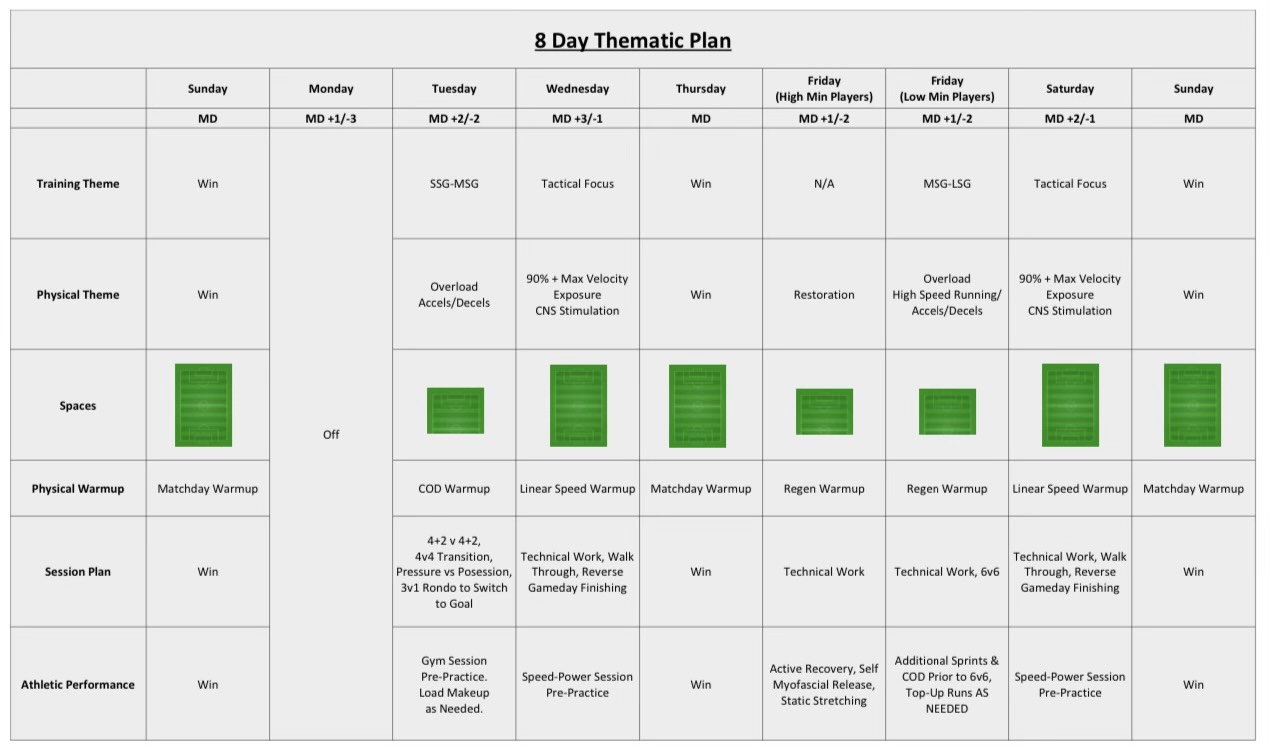
Sample Women’s College Soccer Thematic Plan:
Monday: OFF.
Tuesday (MD +2/-2): COD, SSG-MSG, Gym Session.
Wednesday (MD +3/-1): Acceleration, MSG-LSG (Short Duration), Set Pieces, Mobility.
Thursday (MD 1): Shakeout session approximately 5 hours prior to game. Game at 5 PM.
Friday (MD +1/-2): High Minute Players – Active Recovery, General Strength Circuit, Mobility.
Friday (MD +1/-2): Developmental Group – Speed, MSG-LSG, COD, Repeat Sprint Ability.
Saturday: (MD +2/-1): Plyometrics, Ballistic MB Series, MSG-LSG (Short Duration), Set Pieces, Mobility.
Sunday (MD 2): Shakeout session approximately 5 hours prior to game. Game at 1 PM.
Sample Boy’s Academy Soccer Thematic Plan:
Monday (MD +1): High Min Players – Regeneration, Developmental Group – Speed, MSG-LSG, COD, Repeat Sprint Ability.
Tuesday (MD +2/-4): COD, SSG-MSG, Strength Focused Gym Session.
Wednesday (MD +3/-3): OFF.
Thursday (MD +4/-2): Power Focused Gym Session, Acceleration, MSG-LSG.
Friday (MD -1): Speed, General Strength, SSG-MSG (Short Duration), Set Pieces, Mobility.
Saturday (MD 1): Shakeout session approximately 3 hours before game. Game at 11 AM. High Min Players – Recovery Post-Game. Low Min Players – Acceleration, Plyometrics, and Repeat Sprint Ability Post-Game.
Sunday (MD 2): Shakeout session approximately 3 hours before game. Game at 11 AM. All Players Mobility Post-Game.
Sample Men’s College Soccer Thematic Plan:
Sunday (MD -2): Plyometrics, Speed, MSG-LSG.
Monday (MD -1): Mobility focused warmup, LSG (Short Duration), Starters – Walk Through, Developmental Group – MSG.
Tuesday (MD 1): 10-15 min team walk approximately 8 hours prior to kickoff. Game at 7 PM.
Wednesday (MD +1/-3): High Min Players – Active Recovery, Low Min Players – MSG-LSG.
Thursday (MD +2/-2): Acceleration, COD, SSG-MSG.
Friday (MD +3/-1): Mobility focused warmup, LSG (Short Duration), Starters – Walk Through, Developmental Group – MSG.
Saturday (MD 2): 10-15 min team walk approximately 3 hours prior to kickoff. Game at 12 PM.
Sunday (MD +1/-3): OFF.
After reading through each of the thematic plans, I’m sure you have noticed similarities and differences. In general, the outline for each of the thematic plans is similar. However, some of the activities are different. The differences in activities mainly stems from preferences of the specific coaching staff and/or group of athletes I was working with at the time. In some cases, I
came into a setting where the coaching staff was open to my ideas and allowed me to operate with more autonomy. In other cases, I came into a setting where the staff had developed a system over many years that they have seen a lot of success with. As I mentioned earlier, to develop an effective thematic plan, strong communication and collaboration with sport coaches and other support staff members is key. Being able to share ideas, make compromises, and consider what has worked well for a specific group in the past is key in collaborating with all stakeholders, and developing an effective thematic plan.
When setting out to develop an effective thematic plan, you must go in with a holistic focus. For a thematic plan to be effective you must work together with all stakeholders. You cannot take a narrowminded approach. You must be willing to learn about the sport you are working with and try to understand what your coaching staff is trying to accomplish from a technical/tactical standpoint. Sometimes you must be willing to follow the coaching staff’s outline and plug in physical training that will compliment it as best as possible. As a performance coach, the best thing you can do is try to get everybody on the same page.
In some way shape or form, the entire coaching staff and support staff should be involved in the development of a thematic plan, as this ensures clarity towards a unified goal. Once the plan is agreeable for everybody, a copy of the plan should be kept on hand by all parties to refer to over the course of the week. Working to develop a thematic plan is a great way to add value as a performance coach. It shows that you’re not just thinking about lifting heavy weights, and that you care about successful performances just as much as everybody else. A thematic plan ultimately serves as a framework to work towards achieving common goals as a staff. A thematic plan considers all the physical, technical, and tactical activities a group will endure over the course of each training week. From there, you’re just trying to consolidate stressors, allow for adequate recovery, and make sure your athletes are healthy and ready to perform when it matters most.