
A practical walkthrough of using surveys, decision trees, and training automations to reduce latency and keep athletes in the right bucket all season long.
In high performance environments, the limiting factor often is not access to data. It’s time.
Coaches can collect more information than ever, from subjective wellness surveys to force plates, GPS, and velocity tracking. The challenge is turning those inputs into decisions quickly enough to matter, without getting pulled into an endless cycle of manual analysis.
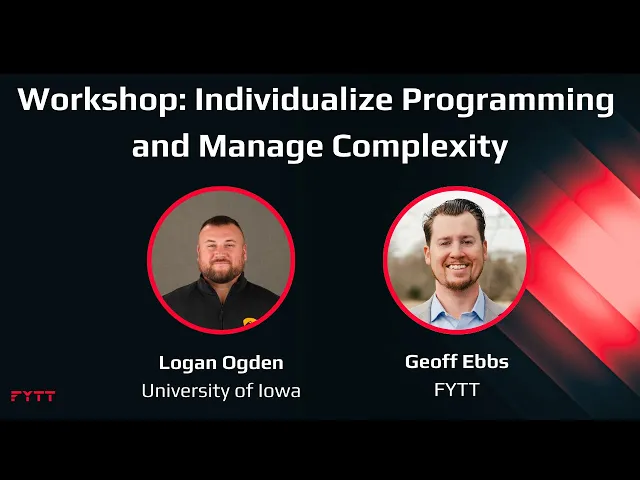
In a recent conversation, Geoff Ebbs (FYTT) and Logan Ogden (Director of Athletic Performance, University of Iowa Men’s Basketball) broke down the practical systems they use to reduce decision time and increase consistency across a season. The throughline was simple: build a framework once, then deploy it automatically so coaching decisions happen faster, more frequently, and with less friction.
1) The real bottleneck is latency
Geoff described the most common breakdown in modern performance workflows:
You collect data today, but you might not have time to review it until days later. By the time you act, the moment has passed.
That delay is the “latent period.” It shows up everywhere:
Wellness flags that are noticed after the week is already heavy
Training adjustments that happen too late to matter
Staff spending hours sorting and re-sorting athletes instead of coaching
The solution is not more data. It’s reducing the time between input and action.
“I can take my model and automate it so it’s done consistently. It decreases the latent period.” - Geoff Ebbs
2) Surveys work when you treat them like signals, not truth
Logan shared how he uses athlete surveys to build a better picture of readiness without becoming beholden to self-reported numbers.
He uses surveys as a daily snapshot, then compares those subjective inputs to objective signals like force plate metrics, game loads, and training exposures. The survey is not the decision. It helps explain the decision.
“The survey paints a framework of what the athlete is feeling. Then I compare it to force plates, games, and training to get a better idea of what’s going on." - Logan Ogden
He also emphasized the biggest constraint: athlete honesty. Some athletes will auto-fill “perfect” scores unless you coach the why behind the survey. “I don’t take surveys completely at face value. I do more digging after the fact.”
One practical takeaway from the conversation: surveys do not need to trigger binary outcomes. They can also trigger resources.
Geoff highlighted an approach used by Corey Peterson (St. Thomas) where survey responses can assign athletes extra “toolbox” work, check-ins, or support resources. This keeps the response proportional to the signal instead of forcing every athlete into an all-or-nothing training change.
3) Load management is easier when you bucket athletes by real stress
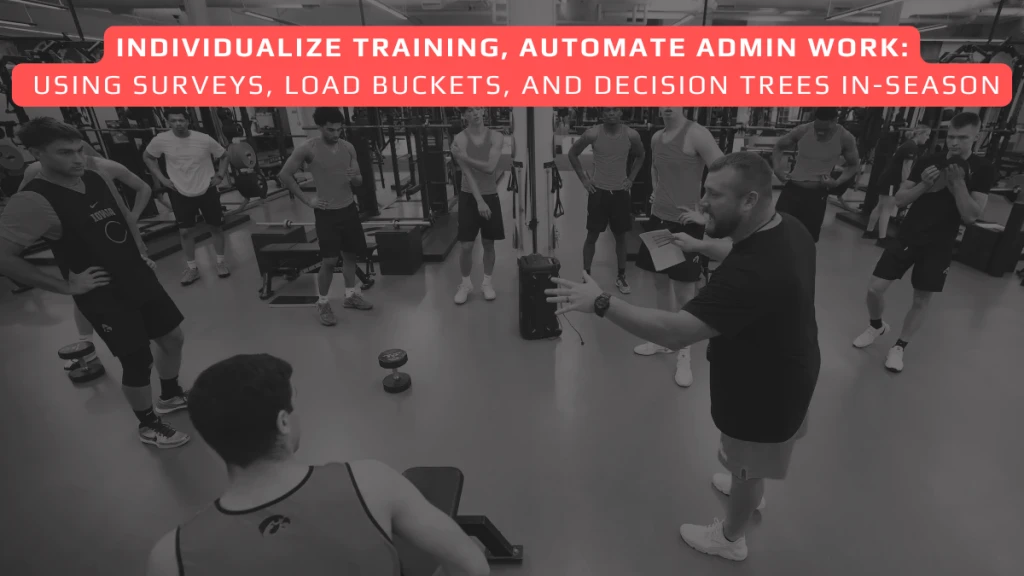
Logan walked through a simple in-season decision tree that automatically assigns athletes into training buckets using two inputs:
minutes played
tactical priority
The buckets were labeled to avoid negative athlete perception:
Speed-Power (high minutes)
Power-Strength (medium minutes)
Strength-Power (low or no minutes)
He intentionally avoided labels like “no minute group.” “I name them that because I don’t need guys saying, ‘I’m in the no minute group.’”
The key outcome: Logan builds three programs ahead of time, then uses the decision tree to move athletes between them day-to-day. That keeps the workflow fast without removing the coaching eye. “I make three different programs, then the automation moves guys in and out daily. I’m not constantly evaluating and printing different workouts for each guy.”
Geoff summed up the value as a dynamic programming model where 90 percent of the work is done upfront, and the final 10 percent is small daily adjustments.
4) Automations do not replace coaching, they preserve coaching bandwidth
A consistent theme from both speakers: automation is not “hands-off” coaching. It’s a way to protect time for the parts of coaching that cannot be automated.
Logan put it clearly: “The coaching eye doesn’t go away. It just helps you be organized and increases the speed at which you can make decisions.”
He also shared how this improves the coach-staff relationship because information becomes instantly accessible. “The ability to give information instantly has significantly improved. I can give them a link and they can see everything right there.”
5) Beyond minutes, the same structure works for GPS, force plates, VBT, and dynamometry
Geoff and Logan walked through several examples of the same underlying concept: define the KPI, define the threshold, then automate the assignment.
Examples discussed:
GPS threshold attainment (if an athlete does not hit a high-speed exposure, add a sprint supplement)
force-velocity profiling to bucket training emphasis
force plate flagging systems for small exercise swaps that add up over time
dynamometry ratios (like adductor/abductor) to trigger supplemental work quickly rather than waiting weeks
One of Geoff’s most useful reminders was that you can use multiple KPIs in the same decision, using AND logic and OR logic depending on the goal.
A simple framework to build your own system
Geoff closed with a practical checklist for building a cohesive monitoring framework:
Identify the principles that drive your model
Define your KPIs the way you coach them, not the way the device labels them
Analyze data streams concurrently, not in isolation
Monitor frequently, change judiciously
Value your experience as a coach
The goal is not complexity. The goal is consistency at speed.
Watch the full recording
What we covered
In this session, Geoff and Logan walked through a practical automation framework for high performance environments:
Communication and workflow: how fast access to clean dashboards improves staff alignment
Reducing “latency”: how to shorten the time between collecting data and making training decisions
Survey design that actually gets used: how to interpret subjective inputs alongside objective signals
Load bucket assignment in-season: minutes played + tactical priority to drive daily training emphasis
How conditional logic works: AND/OR rules, decision trees, and when to override with coaching judgment
Applying the same approach across data streams: GPS thresholds, force plates, VBT profiling, and dynamometry flags.