
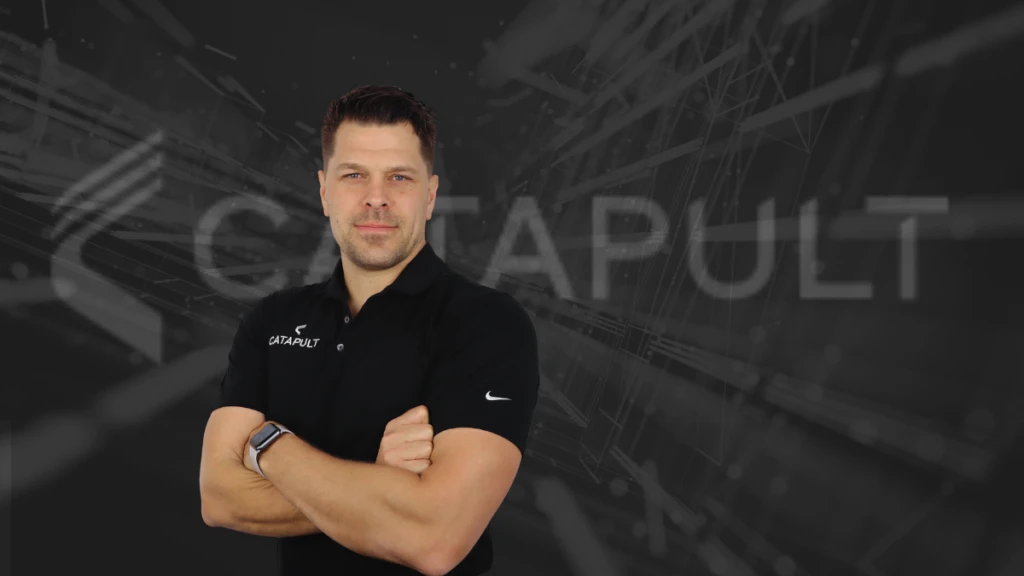

In today’s elite sport environments, success depends on more than raw talent. Teams that thrive are those that effectively combine performance data with applied coaching strategies. Mathew Pell, Senior Applied Sports Scientist at Catapult Sports, shared how athlete monitoring can transform practice design, guide return-to-play processes, and create alignment between performance and medical staff.
He highlighted several themes that shape how practitioners can apply athlete monitoring in high-performance settings:
Athlete monitoring integrates prescription, communication, and context.
GPS and wearable technologies provide the foundation, but practitioner judgment determines how those numbers influence training.
Effective monitoring systems require clarity: what to measure, who communicates results, and how the information supports decision-making.
Cultural buy-in matters as much as technology. Coaches and athletes must trust the process, not just the numbers.
Applying Athlete Monitoring in Practice
Why Monitoring Matters
Athlete monitoring is not a luxury in elite sport. Continuous play, frequent travel, and high game demands mean athletes are constantly at risk of overload. As Pell explained, Australian Rules Football provided one of his earliest laboratories for testing monitoring systems. Midfielders cover more than 14 kilometers in a game, often at 135 meters per minute. Without structured monitoring, recovery, readiness, and injury prevention would be left to guesswork.
Journal of Science and Medicine in Sport research reinforces this: systematic monitoring is directly tied to injury reduction and performance stability across long seasons. Coaches can also see parallels with frameworks such as The Athletic Performance Curve, which show how adaptation follows structured loading and recovery.
From Data to Decisions
Technology like Catapult’s GPS and accelerometers can produce thousands of data points each session. But, as Pell stressed, the goal is not collecting data. The goal is applying it in ways that inform decisions.
“Athlete data is powerful only when it informs decisions in real time.”
This requires translation. Coaches need information framed in their language: high-speed running totals, sprint counts, or workload comparisons to typical game demands. Strength coaches may need force-velocity profiles or acceleration density charts. Medical staff may focus on return-to-play markers.
Frontiers in Sports and Active Living has shown that the most effective monitoring systems are those where practitioners adapt the same dataset into different “languages” for each audience. FYTT has also emphasized this in its guidance on decision trees in high-performance sport, where clarity of communication is as important as the numbers themselves.
Return-to-Play: A Critical Case
Injured athletes highlight the importance of prescription management. When returning, athletes are vulnerable both to overloading (risking re-injury) and underloading (failing to regain readiness). Clear role definition between performance staff and medical teams is critical.
Pell explained that terminology matters: he avoids “load management” in favor of “prescription management.” Load implies restriction; prescription implies purposeful planning. This subtle shift builds athlete trust and encourages adherence.
“It’s not about load management. It’s about prescription management.”
Research from the British Journal of Sports Medicine supports this communication-first approach, showing that return-to-play programs succeed when all stakeholders share common terminology and expectations. Coaches may find it helpful to compare these frameworks with FYTT’s article on baseline testing, which similarly uses measurable progressions to guide safe re-entry.
Building Buy-In
Even the best monitoring system fails if athletes or coaches don’t trust it. Pell emphasized communication: not just showing charts, but sitting with coaches to explain what sprint density means for today’s practice, or helping an athlete see how today’s prescription sets them up for success in Saturday’s game.
A recent editorial by Tim Gabbett (“Load Management: What It Is and What It Is Not!”) emphasizes that practitioner credibility plays a big role. Athletes respond best when guidance reflects measurable, meaningful preparation rather than just risk control. FYTT expands on this in its feature on leadership in strength and conditioning, where relationships and trust are as important as programming.
"The practitioner's job is to talk the coach's language, not overwhelm them with spreadsheets."
-Mathew Pell
Q&A with Mathew Pell
FYTT: Matt, what first drew you to athlete monitoring as a discipline?
Pell: I started in Australia, working across cricket, Australian Rules Football, and with referees. I realized quickly that games weren’t won just on skill. Conditioning and load prescription determined whether players could sustain performance over weeks and months. Monitoring provided the framework to keep players available and effective.
FYTT: What makes AFL such a demanding testing ground for monitoring systems?
Pell: The size of the field and nonstop play mean that the demands are enormous. Midfielders might run 14.5 kilometers in a game. That’s very different from American football or even soccer. It forced us to get serious about microcycle planning, monitoring outputs, and adjusting prescriptions week by week.
FYTT: How do these lessons translate into American sports?
Pell: Soccer is similar in terms of running demands. In football, positions are different — a wide receiver has unique sprint and acceleration needs. Monitoring allows us to tailor conditioning and practice design to each role, not just the team average.
FYTT: Catapult is known for its GPS and tracking tech. How do you avoid drowning in data?
Pell: It’s all about validation, application, and communication. First, validate that the data is reliable. Second, apply it in context. Compare today’s session to typical game outputs. Finally, communicate it in simple terms. Coaches don’t want spreadsheets; they want insight that helps them make a decision today.
FYTT: What’s one mistake you see practitioners make?
Pell: Thinking monitoring is just about avoiding injury. Yes, that’s part of it, but it’s also about optimizing readiness. Monitoring helps us know when to push harder, not just when to pull back.
FYTT: Where is innovation headed?
Pell: I’m excited about acceleration density metrics, force-velocity profiling, and integrating wearable and video data. These tools let us individualize preparation and sharpen prescriptions.
Watch Pell’s full presentation on YouTube.