

Athletes recovering from injury face two parallel tracks: medical treatment from athletic trainers (ATs) and performance preparation from strength and conditioning (S&C) coaches. When those tracks run separately, athletes often return to practice without being fully prepared for the physical demands of competition, which increases the risk of setbacks and repeat injuries.
In this FYTT webinar, Jamie Jaeger, a certified athletic trainer at the University of St. Thomas, explains how blending sports medicine with strength and conditioning creates a continuous process instead of a handoff. She highlights five phases of the return-to-sport continuum, the shifting leadership roles of staff, and the communication habits that keep athletes progressing safely.
The Five Phases of Return to Sport
Jaeger outlines the return-to-sport process as a five-phase continuum. Instead of seeing rehab and training as separate silos, this model emphasizes overlap, communication, and clarity about who is leading the process.
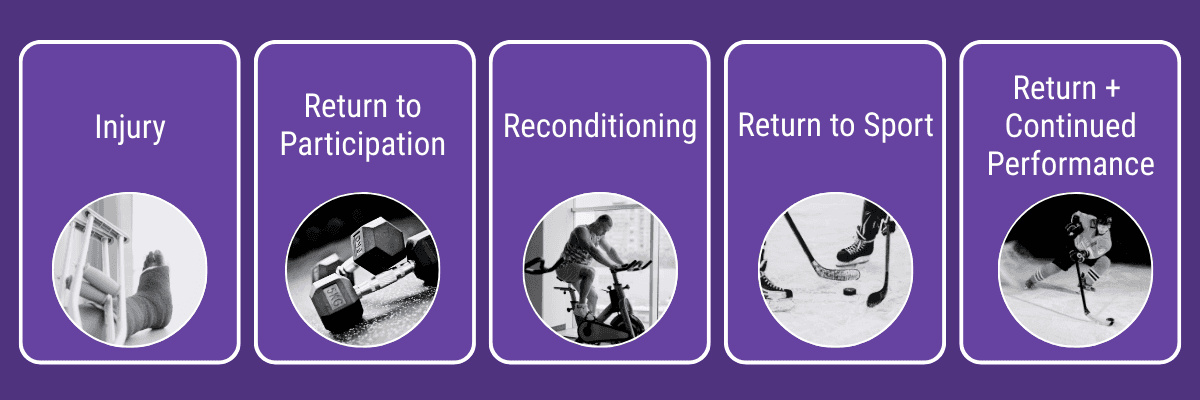
1. Injury
Quarterback: Athletic trainer
The AT manages the initial response, diagnosis, and treatment plan. Clear communication with physicians, coaches, and the athlete sets the stage.
“When that injury happens, I’m the quarterback. I’m the one making the calls and making sure everyone else knows where the athlete stands.”
2. Return to Participation
Quarterback: Athletic trainer
The athlete begins modified activities. The AT evaluates how the body responds before allowing more load or intensity.
“In those first return-to-participation days, I’m still the quarterback. I need to see how the athlete is responding before we hand off more responsibility.”
3. Reconditioning
Quarterback: Shared role between AT and strength coach
The athlete transitions from medical clearance toward physical readiness. The AT monitors symptoms, while the S&C coach reintroduces strength, conditioning, and movement. Success depends on constant dialogue and a unified message.
“Reconditioning is when we’re both in the driver’s seat. I’m looking at symptoms, the strength coach is loading, and we have to communicate constantly.”
4. Return to Sport
Quarterback: Strength coach
The athlete resumes full practice. The S&C coach now drives progression with speed, power, and sport-specific training, while the AT provides ongoing checks to ensure tolerance.
“Once they’re back to sport, the strength coach is the quarterback. I’m still watching from the sideline, but now performance drives the progression.”
5. Return + Continued Performance
Quarterback: Strength coach, supported by AT
The athlete competes at full capacity, but monitoring does not stop. The S&C coach focuses on performance and long-term development, while the AT remains engaged for recovery and wellness.
“Even after they’re back, the continuum doesn’t stop. We still need to collaborate so the athlete keeps performing and doesn’t end up back in the training room.”
This continuum reflects evidence-based approaches described in the Return-to-Sport Clearance Continuum, which emphasizes staged criteria and role clarity at every step.
Communication and Shared Language
Integration only works when staff share information and vocabulary. Jaeger stresses three habits:
Daily updates: Quick check-ins to flag athlete status as red, yellow, or green.
Unified definitions: Agreeing on terms like “clearance” or “modified” so there is no confusion.
Shared tools: Using common documents or platforms such as FYTT to track data in one place.
This prevents athletes from feeling like they are caught between competing voices.
“Athletes should never feel like they are caught between two voices. Collaboration means one unified message.”
Research in applied settings confirms that clear communication between staff improves outcomes, especially when shared strategies are used consistently across teams. See Frontiers in Sports and Active Living.
Monitoring Load Across the Continuum
Jaeger also highlights the role of load monitoring in progressing athletes safely. Both objective and subjective markers guide decisions:
Session RPE
GPS metrics like distance covered or sprint counts
Swelling, soreness, and recovery reports
Athlete feedback
“Monitoring the right load markers is like having a speedometer. It shows when to push and when to back off.”
These markers align with frameworks like the Control-Chaos Continuum, which guide safe progression by balancing structure with sport-specific chaos.
Studies also show that structured testing batteries, such as those used in ACL recovery, strengthen return-to-play decisions. (Refer to ACL RTS Consensus.)
Integrating these markers with clinical insight allows staff to advance athletes without overloading them. This approach complements FYTT’s applied frameworks on the athletic performance curve, individualized fitness, and decision trees in sport science.
Similar staged frameworks have been applied in football and other sports to ensure athletes progress under both medical and performance oversight (Football RTS Case Study; Shoulder Stabilization RTS Criteria).
Building a Culture of Collaboration
Technical frameworks matter, but culture determines whether integration succeeds. Jaeger encourages programs to:
Establish mutual respect between ATs and S&C coaches.
Hold regular meetings to review progressions and program changes.
Present unified messaging so athletes hear one plan instead of conflicting directions.
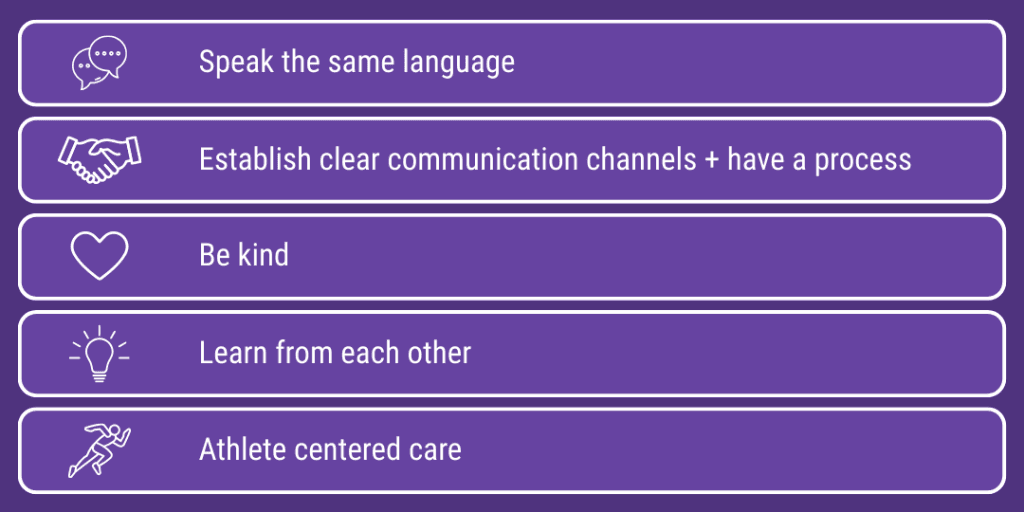
This cultural foundation echoes lessons from leadership in strength and conditioning, where communication and trust define success.
Q & A
FYTT: You describe the return-to-sport model as a continuum. Why is that important?
Jaeger: It is not a handoff. We are not moving athletes from the training room to the weight room and stepping away. Our roles overlap. That overlap is where the athlete gets the best care.
FYTT: How do you handle communication with S&C staff day to day?
Jaeger: We do a lot of quick check-ins. It can be a conversation in the hallway or a note in a shared document. The important thing is that no athlete moves forward or back without both perspectives.
FYTT: What markers help you know when to progress an athlete?
Jaeger: We use a mix of things. Session RPE, GPS numbers, swelling, soreness, and how the athlete feels. When all of those line up, we can move forward. If something is off, we adjust.
FYTT: What cultural advice would you give to programs that want to do this better?
Jaeger: Respect each other’s roles. Set up structure with regular meetings and shared language. And always present athletes with one clear message. That way, they know we are working together.
Integrating sports medicine with strength and conditioning ensures athletes are guided through every stage of recovery and performance. By following the five-phase continuum, assigning clear leadership roles, and maintaining constant communication, coaches can protect athletes and accelerate their return to competition.